

1Founder (n): : the original builder of a city or edifice.
2Founder (v): to experience failure; to be unsuccessful; to fail.
Chapter 1
The Peugeot, November 2021
A voice in his head repeats the plate number three times.
VH-778-GDT
VH-778-GDT
VH-778-GDT
Stop, Hugh Warding says to himself.
And the voice stops.
He memorized the plate number at least an hour ago, but his mind repeats it out of sheer compulsion.
The car is a black Peugeot. Relatively new. Exceptionally clean. VH indicates a Vorhol registration, but that tells him next to nothing. It’s probably not an unmarked Sikstand car, he decides. Their plates usually have an SK prefix, which every kid in the dodgy part of Campus Augustus grows up learning to spot. Nothing about this vehicle looks official: no low-profile shark-fin antenna or emergency lights hidden behind the grill. Just a plain black Peugeot with a reflective windscreen.
He doesn’t know anyone who lives in Vorhol. In fact, he doubts anyone actually resides there; the place is almost entirely office buildings, occupied by lobbyists, contractors, and NGOs—all of them requiring proximity to the capitol. At night the area is a ghost town.
As he watches the car idling in traffic just 50 meters away, it dawns on him that the Propago Foundation is headquartered in Vorhol—just north of the capitol complex at Doma Lage. He noticed their address when he checked the foundation’s website. Until then, he’d never heard of Propago, and he certainly paid Vorhol no mind.
It could be an odd coincidence, of course, that a man from Propago called out of the blue to offer him help finding a DNA match, and a week later Hugh is being tailed by a car with a Vorhol plate. But none of this feels coincidental. No, he’d been rash to speak so unguardedly to a complete stranger, just because the man had an impressive title and Hugh had run out of options in his search. Bloody stupid.
Just then the Peugeot turns right, slides into a column of slow-moving cars, and is gone. For several seconds, Hugh remains stock-still as if the vehicle might suddenly reappear, specter-like, in the red haze of rush hour traffic. Standing there on a crowded sidewalk in Gloven, he has a sudden urge to call the Sikstand and report the car, to recite VH-778-GDT to the dispatcher so she can check the registration in the motor vehicle database and track down the driver—or whatever they do in such situations. But she will probably ask what, exactly, had been suspicious about this black Peugeot, and Hugh will say that it had been showing up everywhere he walked that afternoon—had been parked by the Indian restaurant when he stopped for lunch, and across Fornish Street when he smoked a cigarette before starting home. How did he know it was the same car? the Sikstand dispatcher will ask. Because I saw the fucking VH-778-GDT, he will inevitably blurt out, feeling the cortisol coursing through his body. Swearing at the dispatcher will only infuriate her, though, and make him sound like a lunatic, so he doesn’t call the Sikstand, but lingers there on the curb, in the failing light of a cool November evening, the voice in his head resuming its chant, VH-778-GDT.
To this point, he has tried to look unconcerned by the car’s repeated appearances, to walk as if he were on routine errands, oblivious of his pursuer; but now, as he heads down Huguenot Street, he finds his pace quickening, and the click of his heels on the sidewalk growing as rapid and percussive as a snare-drum. He glances over his shoulder at the intersection behind him, then at the street to his left where traffic crawls along in the deepening gloom.
Nothing.
Good, then.
Another 100 meters on, he turns onto Mission Gate Road. Halfway up the block, he stops by a Vodafone store and pretends to look at mobile phones in the window. Traffic is lighter here, though parked cars crowd the street on both sides. A quick glance to his right. Still no black Peugeot. He continues walking, now with less urgency, looking in store windows as he goes—a gluten-free bakery, a women’s clothing store with feathery hats displayed on styrofoam Greek columns, an old-style tobacconist with a leather club chair in the window. He is about to pass this last shop when he decides to step inside for some cigarettes—and to disappear, at least briefly, from view. A bell jangles overhead as the door swings inward; at the counter a pot-bellied man with a chest-length beard stands to greet him, his bulging midsection pressing against the display case. The lighting is dim, the air hazy-blue and thick with cavendish tobacco smoke.
“Evening, jim,” says the fat man. “How can we help?”
“Pack of plugs,” replies Hugh. “Gauloises Blondes Blue.” As he speaks, he scans the store’s interior as if the car might be lurking under a display table.
The proprietor turns to a rack behind him, runs his index finger across several rows, and reaches for the requested sapphire-blue pack. “Got an ID?” he asks.
“Come on, jim,” mutters Hugh reaching for his wallet. “I’m pushing 30.”
“Sorry, mate. BMMH has been up our ass lately for not carding,” replies the man wearily. “We gotta check everyone now—no matter how old they look.”
Hugh hands over his ID card and the man scans it with his barcode reader, then waits for the ID to clear.
“Twelve bone for the plugs,” says the man.
Hugh hands over a 20-euro note and receives his change. Then, taking his cigarettes and ID card, he turns to leave. As he moves toward the exit, however, he realizes he has only a partial view of the street; a powerful reluctance overtakes him. He pauses at a tabletop display near the door and feigns interest in a crystal ashtray.
“That’s a Baccarat right there,” calls the man from the counter. “Top of the line. You a cigar smoker?”
“Nah,” says Hugh. “My dad was, though.”
“That right? What did he smoke?”
“Swiss Delites,” offers Hugh reluctantly.
“Right,” replies the man. “We don’t carry them. More of a grocery-store brand, if you know what I mean…”
Too distracted to take offense, Hugh turns the ashtray in his hand while keeping the street in his peripheral vision. Then, seeing the price tag of €695, he carefully sets it back on the table and turns to the proprietor. “You got the time?” he asks.
The man checks a wristwatch on his thick, tattooed arm. “Ten past six.”
Hugh looks out at the street again. All clear, and then...
Bloody hell.
A black Peugeot is turning onto Mission Gate, moving slowly toward the tobacco shop, its windscreen silvered by the glow of a storefront. As the car approaches, Hugh can vaguely make out a figure at the wheel, but little else. At 20 meters he can read the registration number. VH-778-GDT.
As his unease mounts, the voice in his head sounds off again, now rhyming obsessively.
GDT.
Cup of tea.
Needle pricks sweep up his spine and along the base of his neck. He backs away from the table display and retreats toward a walk-in humidor at the rear of the store. Stealing another look at the street, he sees the car has stopped just outside, its headlights on, the bonnet glazed with drizzle.
Noticing that Hugh is headed for the humidor, the proprietor calls after him, “We’re running a special on Ashtons. In case you wanna try something nice and mild.” Hugh nods but does not reply. In his ears the rush of blood sounds like a driving wind.
Mild. Mild. Mild.
He feels himself grow light-headed.
Slow the breathing, he reminds himself.
In for four.
Hold for seven.
Out for eight.
As he steps into the glass-fronted humidor, his left eye squeezes into a hard, uncontrollable wink, releases, then winks again. Were he at his flat, or mixing drinks at Bar Bruka, he would take a moment to practice deep breathing and pacify his nerves. But here in the tobacco shop with that car idling outside, his only thought is to vanish into the air like a puff of smoke. Inside the humidor the cool air smells of cedar and leaf tobacco. Racks of cigar boxes line the walls, and in the center of the humidor stands a battered work table on which sit stacks of thick tobacco leaves and a cutting tool. Behind the table, on a gray metal door, a sign reads, Employees Only.
He glances back at the proprietor who is now reading something on his mobile.
Without calculating the risk or even much caring, Hugh tries the latch on the door. It clicks and turns. No alarm sounds; the shopkeeper remains engrossed in his reading. Drawing a deep breath, Hugh cracks the door open and slips through.
He finds himself in a narrow, dimly lit hallway with occupational safety posters taped to the walls. As he makes his way down the corridor, he passes a WC, then a time-clock, eventually emerging into a small room cluttered with shelves stacked with boxes. Against the wall, a metal security door has a sign posted at eye-level: “Turn off the lights when you leave for the day.”
He hurries to the door and gropes frantically at the doorknob.
It doesn’t budge.
Just then, he hears footsteps behind him in the hallway.
He tries the thumb-turn lock above the doorknob.
Leave for the day. Leave for the day.
Hey, hey, hey.
The lock resists, then stiffly turns.
“Hold it right there!” bellows a voice behind him.
Without looking back, Hugh rams the door open with his shoulder and bursts into an alley. Sprinting into the darkness, he glances over his shoulder to see the fat man standing in the doorway, breathing hard, one hand on the doorknob. As Hugh nears the end of the alley, he spins around to look at the tobacconist.
The big man takes a few uncertain steps into the alley and pauses, his chin raised as he peers into the darkness.
For a split second, Hugh considers going back and telling the man why he’d fled—that he didn’t steal any cigars, that he isn’t that kind of person. But instead he turns back around and keeps running.
Book I, Chapter 2
Tullia, June 2021
He hasn’t seen Tullia since she came by the bar two weeks ago. She is back now, stepping off the lift like Cleopatra from a pleasure barge, her eyes roving the room for anyone she knows, or anyone who matters. Her intensely self-conscious entrance is typical for the scions of Bressen’s founding families—gantlings, as they’re called by the figan underclass—as if even walking into a crowded bar has been choreographed by a manners consultant to the aristocracy. Hugh spots her right away, of course—he’s always got his eye on the lift for her next appearance—and watches surreptitiously as she and her two friends go to their booth. The three women walk arm in arm, as if they are one organism, all arms, legs, and haute couture, led by the figan hostess but not really following her.
Bar Bruka, where Hugh has tended bar for three years, occupies a lavishly renovated three-story warehouse on the tony left bank of the Bressen River. For a decade it has been the favorite place for gantlings to gather for cocktails and a bite to eat before heading out to the nearby nightclubs. Hugh has always preferred old-school figan pubs like the Spotted Pig or the Happy Frank—places with low ceilings and a long history. But even a jaded hospitality veteran like him can appreciate Bar Bruka’s special allure. On any given summer evening, VIP customers can enjoy cocktails on the bar’s open-air terrazzo while the sun descends over Tertahar hill. In the light of especially brilliant sunsets, the river itself seems to catch fire, and the gothic spires of Doma Lage, nearly a kilometer down river, look as if great shards of red earth have heaved up from the embankment. The bar’s interior radiates a moody, Mediterranean opulence, with its heavy-gauge copper bartop, booths upholstered in Hermès leather, and the City’s finest selection of whiskey and rye glittering under LED lights.
Usually Tullia gives him a discreet wave when she arrives—to set the hook firmly in his cheek. But tonight she hasn’t acknowledged him yet, so Hugh makes a point of looking occupied by preparing two Kir Royales and then checking his POS monitor for the next order. As he does, Tullia rises from her booth, smooths the fabric of her dress, and walks toward him. Seeing her approach, Hugh smiles a calculatedly restrained smile. A second later, Tullia slips onto a barstool, watching him carefully with her glittery eyes. She’s wearing her honey-blonde hair back in a single braid, and silver eyeshadow that forms a sort of sequined mask around her eyes and brows.
“You didn’t wave when I came in,” she complains.
“Guess I didn’t see you,” says Hugh.
Tullia rests her elbows on the bar and leans toward him, close enough for him to smell her perfume. “You working late tonight, Hugh Warding?”
She likes to call him by his full name, as if it were one word. Huwarding.
“Nah, got the early shift,” he replies. “I’ll be done at 11.”
“What’re you doing when you get off?” she asks.
Everyone else would ask this question out of a specific interest—like getting together later on—but Tullia’s questions are riddled with elision and never clear.
“Just hanging out with my flatmate,” he says, then chides himself for not thinking of a more evasive answer.
“The law student?”
Hugh nods.
“Ah,” replies Tullia, grinning knowingly. “Sounds like a hot date…”
“Nah. Silvia’s just a friend.”
Tullia smirks, then leans even closer to him. As she does, the strap of her blue dress slips off her shoulder, and, where the fabric briefly falls away from her body, Hugh glimpses the white crescent of her untanned breast. Embarrassed, he directs his attention back to the POS monitor. Tullia, meanwhile, slides the strap back over her shoulder, keeping her eyes on him the entire time.
Absolutely classic.
Now, as Hugh rummages in the cooler for some bottles of Heineken, he tries to shake off the image of her naked breast, as if he’d chanced upon a Greek goddess bathing in the woods, and the vision seared itself in his mind. As he opens the Heineken bottles, Tullia eyes his garnish tray, then reaches over and takes a freshly cut wedge of lemon. She puts the lemon in her mouth, bites down, and smiles at him so that the rind forms a garish yellow grin.
“That’s fetching,” he laughs.
Tullia laughs as well and sets the lemon on a cocktail napkin.
Then, without thinking—or maybe thinking too much—Hugh slips the same wedge into his mouth and smiles back at her. They both laugh, the way people do at an inside joke. When he places the lemon peel back on the napkin, Tullia fixes him with a gaze so smoldering he briefly forgets about the order of Heinekens. Gathering his wits, he sets the beers on a tray, signals for the server, and turns back to Tullia.
“You hitting the clubs tonight?” he asks.
She glances at her two friends chatting animatedly at their table. “Yeah. Le Craze, maybe. Or Napoleon’s Tomb. Haven’t decided yet.”
“Not Club 13?”
“Not anymore,” she says, wrinkling her nose. “Their new deejay is tres grave…”
Hugh nods, though he has no idea what tres grave means.
Now Tullia rises from her barstool, draws her shoulders back, and places her hands palms-down on the countertop. Her fingers are slender and long, with polished pink nails. She wears a gold watch with Roman numerals on her left wrist and a signet ring on her little finger.
“I should get back to my ladies,” she says. Then, apparently struck by a notion, she asks, “You ever go to the clubs, Hugh Warding?”
Hugh hesitates. “Not much. Why?”
He shouldn’t have asked ‘why;’ it makes him sound too eager.
“You just seem like you’d know your way around the club scene,” she says. “With those bad-boy looks.”
“I think you’d be disappointed by my moves,” he laughs, then picks up a towel and begins mopping the bartop.
“I bet you’re brilliant.” She says, then drops her hands to her sides. “I should get back to the table. Don’t be a stranger, Hugh Warding.”
“Have fun tonight,” he says.
He continues mopping the countertop as he watches her return to her booth.
He didn’t mention, of course, that he’d gone to Club 13 just a few weeks ago—hoping to run into her. He even asked his friend Dorian Spalding to go along for moral support. At first, Dory refused, because he knows the club scene all too well from having worked security at Le Craze a while back. Dory’s a third-generation Barbadian immigrant, and the clubs aren’t particularly welcoming to people like him, or native-born figans, or anyone with the wrong accent. Eventually Dory agreed, though, which was a good thing because Hugh wouldn’t have gotten in without him. While waiting in the rope line, Dory recognized a Russian bouncer named Konstantin who waved them both inside. While Dory drank and scowled at gantling men, Hugh prowled the club looking for Tullia. He never found her and gave up the search after half an hour. He did, however, recognize at least a dozen regulars from Bar Bruka, none of whom acknowledged him. Frustrated and embarrassed, he found Dory by the bar and made his ignominious exit.
Hugh hasn’t returned to the clubs since that night, but Tullia shows up at Bar Bruka often enough to keep their flirtation on life support. He has no idea why she shows so much interest in a feegie bartender. Dory thinks she’s doing some slumming before Mummy and Daddy marry her off to an investment banker from Old Town. Even knowing her motives might be questionable, Hugh awaits her every appearance with pathetic eagerness. Recently, Tullia asked for his number so she could send him a TikTok video. Ever since then, the two of them communicate once or twice a week, never about anything substantive, and always with lots of ambiguous emojis. Encouraged by this development, Hugh sometimes allows himself to believe she has more interest in him than just slumming, that maybe Tullia Bruggen has a little rebel in her.
For the next hour, Hugh tends bar while Tullia and her friends drink champagne cocktails, take Instagram photos, and pass their phones around for critiques. After a while he notices their cheeks have grown flushed and their body language more histrionic. Eventually, Tullia’s friend Iris hands her black card to the server and waits to be cashed out. Iris tends to tip poorly unless Tullia embarrasses her into paying more, which seems like an assertion of her social rank rather than an act of generosity. A moment later, when the bill is paid, all three women rise and make their way toward the lift. As they pass the bar, Tullia glances at Hugh and waves goodbye. The other two look at him as well but uninterestedly, the way one might regard a curiously colored pigeon. A moment later, all three women step on to the lift and disappear behind the sliding doors.
Don’t be a stranger Hugh Warding.
When Tullia is gone, Hugh turns to his next order. As he’s scanning the shelf for the El Tesoro, a young man in a black sportcoat and pink shirt approaches the bar and sets his glass forcefully on the countertop.
“I need a redo on this drink, mate,” he says, looking not at Hugh but just over his left shoulder.
“Another round?” asks Hugh.
The man fixes Hugh with a belligerent glare and nudges his glass forward. “Not another round, mate. You need to make it over. I asked for a Pappy 15 neat, and you gave me some horse piss instead.”
Hugh looks down at the glass. “Looks like you drank it all,” he replies.
“No, mate. I spit it out in that potted plant over there.” He gestures at the booth where his three friends have turned to watch the exchange.
Hugh draws a deep breath. “I actually remember pouring that drink,” he says. “Pappy Van Winkle Family Reserve 15—just like you ordered.”
“Nooo,” replies the man, obviously relishing the confrontation. “It wasn’t ‘just like I ordered,’ jim, because it wasn’t fucking Pappy 15, it’s swill. And I’m asking you politely to make it right and pour me a new one.”
“Can’t do that, friend,” counters Hugh. “I know I poured the right bottle, and Pappy 15 costs 200 euros a pour.” Then, summoning his deepest reserves of patience, he adds, “But I’m sorry you didn’t like it, so let me comp you a Woodford Reserve or something similar—to make it right.”
This only inflames the man further. He picks up his near-empty glass and thrusts it at Hugh. “Look, you fucking bosa tail wagger,” he whispers, eyes glinting like obsidian,“you take this glass and fill it with Pappy 15 or I’m talking to your manager and you’ll be out on your feegie ass before closing time.”
Hugh feels his diaphragm tightening; a voice in his head whispers, Closing time.
Hosing time.
Over the man’s shoulder, Hugh sees his gantling friends leering expectantly. Hugh’s manager Moira is on vacation—which means she probably can’t be reached. Mitchell, the assistant manager, is probably in his office, but he’s never reliable with customer service issues. There’s a risk, of course, that this man isn’t bluffing—that he is, in fact, a VIP—and refusing him could get Hugh sacked.
As Hugh considers his options, he scans the bar: gantlings everywhere, with feegies serving their drinks and bussing their tables.
Fuck it.
“Look,” he begins, “you know as well as I do that I got your order right. And if I comp you a Pappy, they’re going to dock me the full 200 bone. You get that, yeah? So let me pour you a nice whiskey and I’ll pretend you didn’t just call me a bosa tail wagger.”
This approach seems to defuse the situation somewhat. The man sighs dramatically through his nose, then makes a show of studying the shelves of liquor behind Hugh. Eventually he points to a bottle and says, “Alright, mate. Brownhill 12. Neat.”
Brownhill 12 is a more expensive selection than Woodford but not worth causing a row over. He takes the bottle down, pours the man a generous serving, and slides the glass over to him. As he does, he feels his left eye tightening into a spasmodic wink; he rubs the sensation away with the back of his hand.
Tail wagger.
Bagger.
The man takes the glass of Brownhill and lifts it slowly to his mouth, then, just as Hugh is turning to check his POS monitor, tosses the drink in his face, dousing him from forehead to sternum. Hugh stumbles back from the bartop, swearing and sputtering, his eyes burning from the alcohol. As he fumbles for a bar towel to wipe his face, he hears the man’s friends burst into uproarious laughter.
“Whoops,” says the man with a sneer, then turns and walks away.
Seconds later, the gantling has rejoined his comrades and Hugh is mopping Brownhill Select 12 Year-Old Bourbon Whiskey off his face, shirt, and countertop. As he works, his eye clenches into a hard, unyielding wink, and the voice in his head grows louder and more intrusive.
Tail wagger.
Tagger.
Bagger.
Under his breath, he whispers, “Stop,” and the voice stops. It’s a trick his father taught him long ago, a sort of biofeedback hack to neutralize his anxiety-induced OCD. His eye is still winking defiantly, though, which Hugh hides by looking down and away from the customer tables. Just as he finishes cleaning up and is turning to the next order, the assistant bartender, a tall, freckled Swede named Oliver, comes over to him.
“What an absolute flogger,” mutters Oliver. “You alright?”
Hugh nods and whispers, “Yeah, I’m good.”
Oliver reaches over and takes Hugh’s soggy bar towel off the counter. “You gonna report that guy to Moira?”
“Nah,” replies Hugh. “It’s over now.”
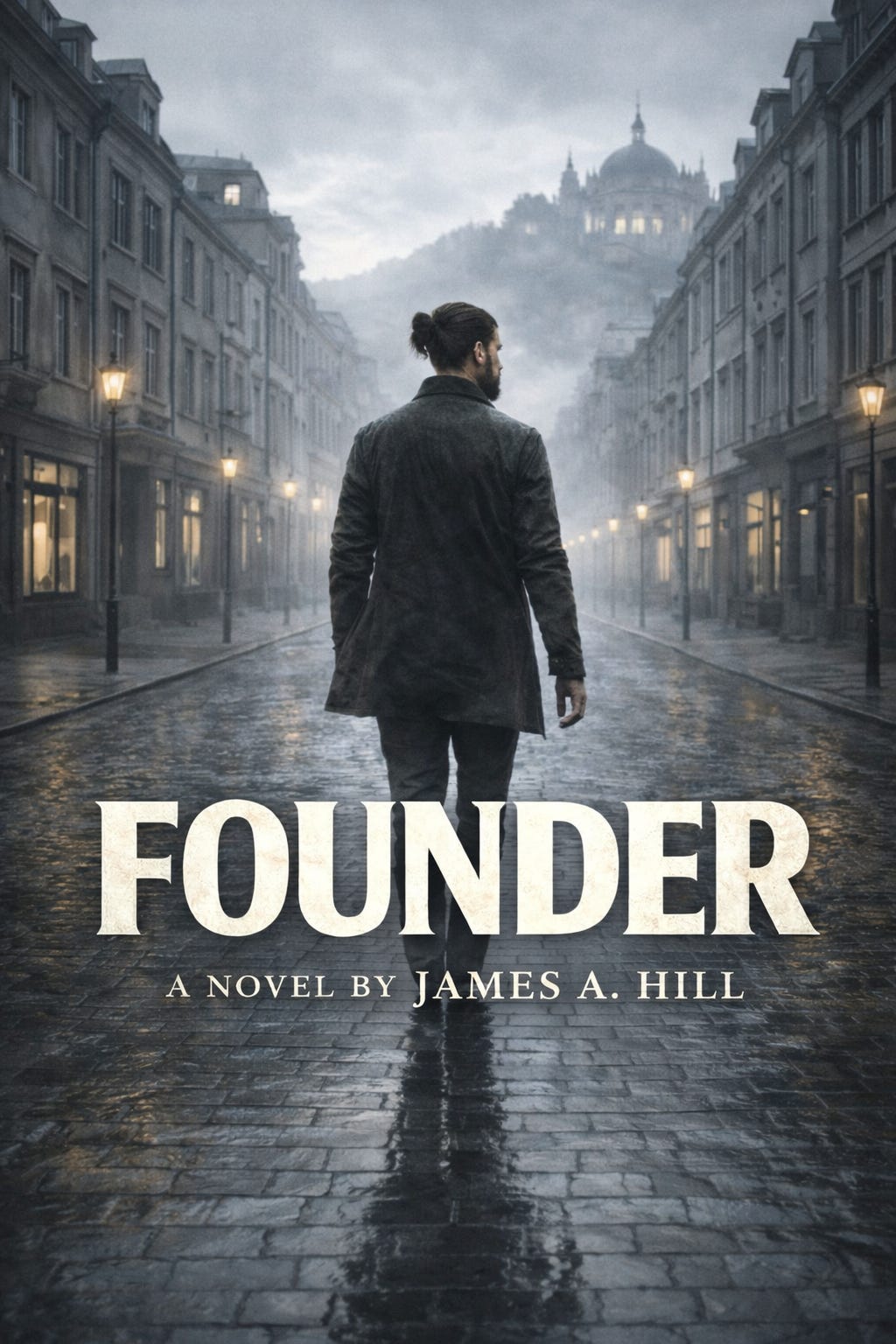
The title Founder calls forth difference and even conflict. At once realistic and surreal, the narrative contains both the familiar and the strange: the believable Hugh and the hallucinatory black Peugeot.Hugh is working at a bar and Tullia is nightclubbing. These different spaces suggest,perhaps,class distinctions. I am very eager to see how these motifs play out.I strongly recommend reading this fascinating novel.
Incredible!