

Chapter 3
Silvia, June 2021
It’s just past midnight when Hugh arrives at the Mission Gate metro station on the trip home from work. From there, he makes his way on foot through the heart of Gloven, with its narrow lanes and shabby row houses, the sidewalks dimly lit by the old iron street lamps. When he comes to The Spotted Pig pub at the corner of Stanfield Street and Morton Mews, he stops to light a cigarette. The pub is closed for the night; above its door hangs a large pig fashioned from sheet metal, at least a meter long and reddened with rust, its metal bulk illuminated by floodlights. He pauses there to take a drag from his Gauloises, then continues walking down Morton Mews to his flat. The mews is dark at this late hour, and he steps cautiously on the cobblestones to avoid turning an ankle. When at last he comes to the end of the lane, he reaches into his trouser pockets for the house key.
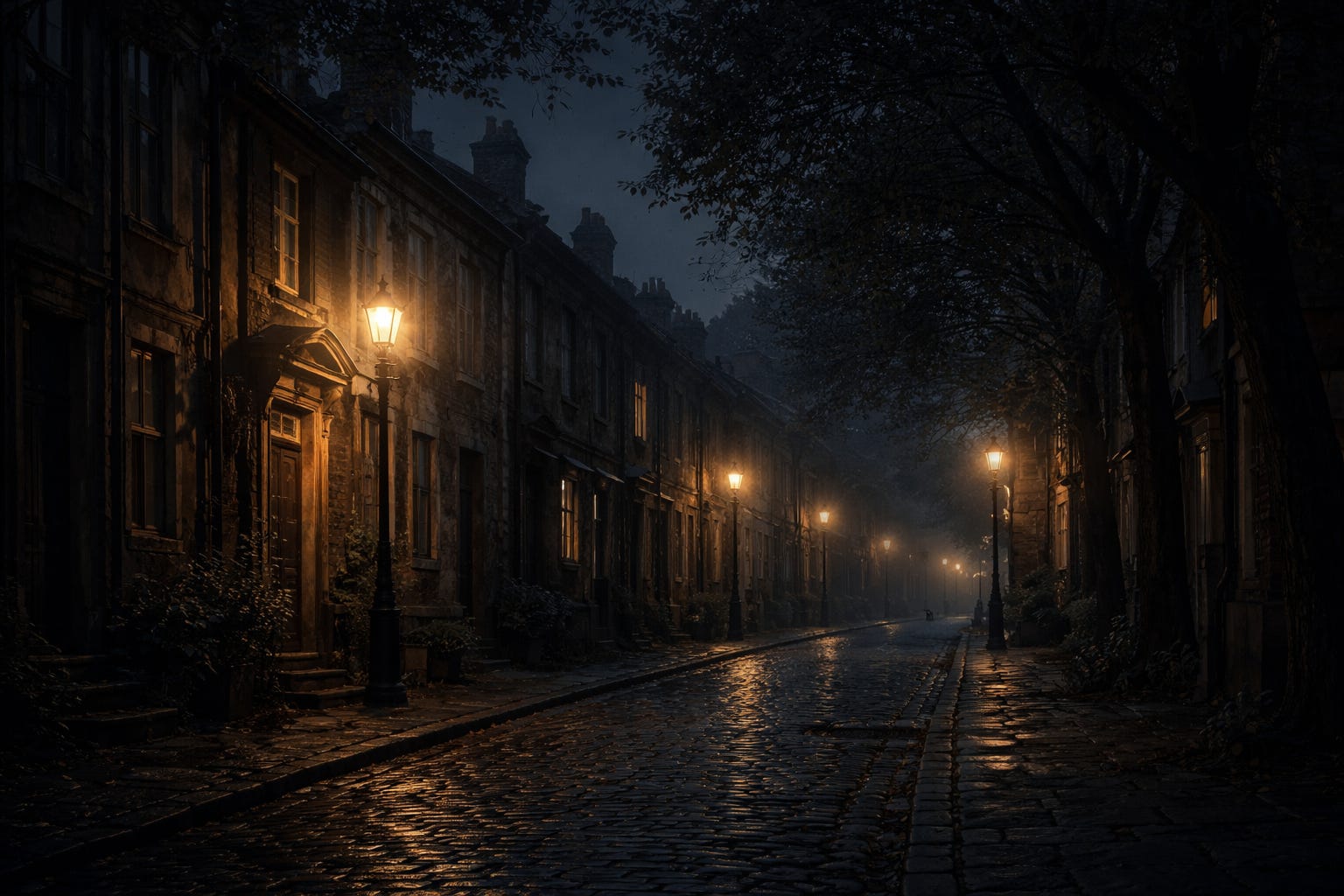
Number 15 Morton Mews is a converted stable house—like almost every other structure on the mews—a compact, two-story brick affair, all white, with a black front door and a wide double door for the horses, also black, and permanently closed. He and his flatmate Silvia live in the upstairs unit, with its window overlooking the mews and a tiny wrought-iron balcony no one dares stand on. The landlord, who lives somewhere in the Vastan district, maintains the property fairly well, though he long ago stripped away most of the building’s 19th-century interior to avoid expensive upkeep. The windows still have the original wavy glass, but the flower boxes typical of mews houses have all been removed. The interior is clean and reasonably up-to-date, though the fireplace has been bricked up, and the beige-walled rooms have a stark, antiseptic quality to them. Silvia found the place on her own—before she met Hugh—and lived there for three months before posting a Facebook ad for a flatmate. By that time, she had decorated the place with help from her parents, who struck Hugh as pretty comfortable for figans—comfortable is how his parents used to describe underclass people with money. They reserved rich for the founding families. While Silvia’s parents struck him as a bit aloof—Mr. Ransor shook Hugh’s hand as if he were tipping a doorman—they had been undeniably generous in furnishing the flat. They bought queen beds for both the bedrooms, a gray sofa with matching chairs, kilim rugs, chrome floor lamps, and framed museum prints for the walls. They even provided appliances for the kitchen—blender, espresso machine, microwave—and all the dishes and flatware.
Hugh moved in a few days after responding to Silvia’s Facebook ad. She had just begun law school at the University of Bressen and wanted a quiet flatmate who wouldn’t distract her from studying. When she interviewed him over the phone, he described himself—only half-jokingly—as a bartender with no meaningful social life, which, Silvia said, suited her just fine. On move-in day, he arrived in an Uber, with just a couple of duffle bags and some cardboard boxes. When Silvia opened the door, she glanced around the landing for the rest of his things. He told her this was all he’d brought.
Hugh met Silvia’s parents the same week he moved in. Shortly after that, they stopped coming by the flat. Silvia explained that they’d had a falling out over her career plans, but he assumed they objected to her new flatmate with the tattoos and man-bun.
Now pausing on his front stoop in the glow of the porch light, Hugh finishes his cigarette and drops the butt into a flowerpot by the door. Silvia hates it when he does this. She says it looks dodgy to have a clay pot full of butt-ends on the stoop, but he reminded her she’d forbidden him from smoking in the flat. Plus he’s careful to empty the pot every few days.
Fitting his key into the lock, Hugh nudges the front door open and steps inside the foyer, where a target-shaped fluorescent fixture hums on the ceiling. To his left is the door to unit one, painted glossy red, to his right a wooden staircase ascending into darkness. He climbs the stairs—eight to the landing, six to his door—reciting a nursery rhyme as he does, to distract himself from counting the steps. He counts most of the repetitive tasks in his life, not because he wants to but because compulsion demands it—brushing his teeth, chewing a mouthful of hamburger, washing the dishes.
Jack Sprat could eat no fat, his wife could eat no lean…
On the upstairs landing, he lets himself inside the flat. The living room is dark except for a floor lamp by the sofa where Silvia is sitting with her feet on the coffee table. She’s wearing a University of Bressen t-shirt and has her favorite orange blanket spread over her thighs, with her laptop open. When Hugh comes in, she sets her computer aside and watches him.
“How was work?” she eventually asks.
Hugh shakes his head. “Total shit show.”
“What happened?”
Hugh drops his keys on the counter, then goes to the fridge for a beer. Back in the living room, he drops into the armchair opposite Silvia.
“I got into it with some gantling douche about his Pappy Van Winkle,” he tells her.
When Silvia asks what Pappy Van Winkle is, he relates most of the story, leaving out how he had whiskey thrown in his face. When he is done talking, she purses her lips in commiseration, then, after a second more, asks, “So, did she come in?”
The question comes somewhat abruptly and, when Hugh tries to judge her expression, he senses not so much curiosity as concern, or even apprehension. Silvia has always been fairly easy for him to read—the way she leans forward from the waist when listening intently; or how she doesn’t quite close her mouth after asking a probing question. Now, sitting there in the glow of the floor lamp, she is doing both, which warns him against making too casual a reply. He studies her face, pleasingly round and olive-toned with a smattering of pale freckles. Silvia’s features have none of Tullia’s angularity, nor her glittery artifice. But, where Tullia’s little deceptions play out in a smile or frown, Silvia’s lack of guile suggests to Hugh a universe of confusions and contradictions swirling inside her. He treads lightly around questions like this—did she come in?—for fear of stumbling upon some hidden wound.
“Yeah,” he replies. “She came in.”
“Did she talk to you?”
He tells her that Tullia did speak with him, though not for very long, and then she left for the clubs the way she always does.
Tucking a dark strand of hair behind her ears, Silvia asks, “So you’re happy about that?”
“I guess,” he says. “But sometimes I think she just wants to show she’s in good with the bartender.”
“You fancy her, though, right?” she insists.
She delivers this last question with such intensity that Hugh finds himself fumbling for an answer.
“I hardly know her, Sil.”
His reply doesn’t seem to satisfy Silvia, who continues studying him expectantly.
“Yeah, I suppose I fancy her a bit,” he concedes. Then before Silvia can react, he adds, “But she’s obviously daft because she thinks I’d be a good dancer.”
At this, Silvia bursts into laughter, and the tension in the room briefly dissipates. She has seen Hugh dance, after all, at the pub when he and Dory got drunk watching a Bressen-United match and then began windmilling to the fight song. He and Silvia have danced together as well, once, after Silvia’s birthday party, when all her friends had gone home. As Hugh was gathering empties from around the living room, a Nora Jones song came on the Bluetooth speaker and Silvia begged him for a dance—for my birthday, she said. So he danced with her, awkwardly, because the song was slow and moody and, when she drew close to him, he could smell her jasmine shampoo. At one point during their dance, Silvia turned to look at the window and, when her nose grazed his cheek, Hugh had a sudden impulse to kiss her. He stopped himself because he knew it was a bad idea to get involved with one’s flatmate and closest female friend. Silvia must have understood that as well, because after the song ended she avoided making eye contact and went straight to bed.
The next morning, she apologized for making him dance. I was a little pissed, she said. He told her it was no problem, that he actually liked it and hoped he didn’t step on her toes.
That sort of awkwardness is mostly behind them now. Hugh’s awful dancing has become their little inside joke. It’s worth a good laugh that Tullia Bruggen, queen of the nightclub scene, should think he has brilliant dance moves. It’s well-timed laughter, as well, and gives Hugh an opportunity to change the subject.
He stretches out his legs, crossing them at the ankles. “So what’d you do tonight?” he asks.
“Studied mostly,” Silvia replies. “I also got dinner with that bloke I told you about.”
“The lawyer from your clinic?”
“Right,” she replies. “Tommy Payne-Havissom.”
“That’s quite the name,” laughs Hugh. “Is it hyphenated and everything?”
She protests that Tommy is a really decent guy—a third-year associate at Holt Winston who volunteers at her clinic; and Hugh, with the air of an older brother, asks if Tommy behaved himself on their date.
Silvia thinks about this, easing herself more deeply into the sofa cushions—hips, then shoulders. “He’s actually a real gentleman. Sort of old school chivalrous.”
“Is he good looking?”
“So you are curious!” she laughs. “He’s…nice looking, you know? A little like Ryan Gosling with a square head. Clean cut. Super polite.”
“Brilliant,” says Hugh half-heartedly. “You found yourself a movie star.”
At this point, the conversation gives way to silence. Hugh drinks from his beer while Silvia leans forward and opens her laptop.
“So what’s her name?” she asks, fingers poised above the keyboard.
“Why? You gonna look her up?”
She nods eagerly.
“Tullia Bruggen,” he says with a sigh. “Two g’s.”
Silvia looks up wide-eyed. “Tullia Bruggen? Really? I know who that is. She shows up on Tattle all the time.”
As Silvia begins typing, Hugh comes over and joins her on the couch. “You read the gossip blogs?”
A blush spreads across her cheeks. “Total guilty pleasure,” she laughs. With Hugh watching, she finds her way to the website, then scrolls through dozens of posts until she finds a photo of two women on a white-sand beach. One of them, deeply tanned in a straw hat, is holding a pink cocktail; the other, wearing a green bikini, appears to be taking the selfie.
“There she is,” says Hugh, pointing to the woman with the cocktail. “That’s the same watch she was wearing tonight.”
Silvia continues to stare at her laptop, her face bathed in its pale blue light. “I had no idea Tullia Bruggen was the woman who’s been flirting with you…She’s like a major socialite, Hugh, and totally gorgeous.”
Hugh says something self-deprecating about Tullia slumming, but Silvia does not respond. She continues to stare at the image, then closes her laptop and sits up.
“But you fancy her,” she says flatly, “so there’s always a chance for love to bloom.” Now she sets aside her orange throw and rises from the sofa. “I should get to bed.”
“I thought we were gonna watch Game of Thrones?” complains Hugh.
“You go ahead,” she replies. “I have class in the morning.”
“See you before you go, then?”
She smiles and turns toward her bedroom. “If you’re up.”
Chapter 4
Maggie, June 2021
It’s been a month since Hugh visited his Uncle Maghil. There isn’t much cause to return to the old neighborhood these days. The trip from Gloven to North Campus Augustus involves a half-hour metro ride and a ten-minute walk, meaning even a short visit with the old man can consume an entire afternoon. Plus, on Hugh’s last few visits, he found Maggie so absorbed in his work he could barely sustain a conversation. Most of Hugh’s secondary school friends have long since moved out of NCA, as well, to find jobs or just escape the place. Were it not for Hugh’s loyalty to his only living relative, he’d just as soon not go back.
Today, though, Hugh’s manager has asked him to visit a restaurant supply warehouse down in Mudo Milar; and the train ride will take him directly through Campus Augustus. Consequently, after finishing his errand in Mudo, and with free time before work, he hops off the train at North Toran and makes his way out through the station onto the familiar sidewalks of NCA. The early June sky is sapphire-blue and perfectly clear; every tree in the city seems to be in bloom, and even the pigeons look more iridescent than usual. From the train station, Hugh follows Lafayette Avenue to where his favorite corner grocery once stood, recently converted into a Bouygues Telecom store that grins over the sidewalk with a giant blue sign. A block farther up Lafayette Avenue, he passes what had been the video arcade where he bought his first pack of cigarettes, now a French bakery. Dory complains endlessly about this sort of gentrification—how rich founders buy up entire neighborhoods, make cosmetic improvements, then raise the rents and drive out low-income figan and immigrant families. Hugh has never viewed urban renewal with the same hostility—it’s not like some neighborhoods couldn’t use a facelift. But seeing his old haunts painted up like Easter eggs, he wonders if Dory has a point.
Turning from Lafayette Avenue onto Barling Street, he’s relieved to see the Madha Forita mission largely unchanged, with its peeling white columns and green copper dome. Even the weedy, pea-gravel courtyard looks the same, and the lilac bushes with purple blossoms drooping over the wrought-iron fence. When he was a kid, local vagrants used to line up in the mission’s courtyard for free coffee and sandwiches. At some point, a priest would come out and walk around greeting people and encouraging them to recite their Murma-Sattmes.
His dad used to say that’s what you get with a civic religion—ATM spirituality. Pop in a prayer and have some priest tell you your problem’s solved.
Those creepy priests are just another reason people of Hugh’s age don’t like the Church: Everything about it—from the prayers in a dead language to the incense that smells like Band-Aids—signals a morally bankrupt institution. His dad used to say that the Red Robes—the six high priests who control the Church’s wealth—were even worse than the founders because they had political power without accountability. And the only thing the Senate feared more than a figan revolution was the Red Robes.
A block past the mission, Hugh comes to Maggie’s building, a converted 19th-century tobacco warehouse that, according to Maggie, no one will ever gentrify because it’s rent-controlled. Very little about the place has changed over the years, the boxwood hedges in the courtyard, the crumbling concrete walkway, the roof tiles overgrown with moss. Hugh turns into the courtyard, walks between the hedges and up the steps, two at a time, the way he used to. He pushes through the heavy double doors and jogs up the stairs, silently reciting, Baa, baa, black sheep.
At flat 3B he knocks on the door—softly, in case Maggie is working. A second later, he hears the old man fumble with the locks. When the door swings inward, he sees Maggie standing there, his hand resting on the knob, looking mildly annoyed. He’s wearing his usual paint-spattered clothes and has his readers pushed halfway up his forehead. But today, for some reason, he is barefooted. His hair and eyebrows are longer and grayer even than the last time Hugh saw him, and his face more drawn, but in every other respect he looks his usual irritable self.
Maggie stares blankly at Hugh, then turns and heads down the hall.
“Grab yourself a beer,” he calls back. “I’m takin’ a break.”
“Can’t drink,” Hugh says. “Gotta work in an hour.”
Hugh follows him down the hall to the main room where his uncle has settled on a green upholstered chair, his bare feet resting on an ottoman. An open bottle of stout rests on the floor by his chair. Afternoon sunlight slants through one of the flat’s tall archtop windows, the center pane of which Maggie has tilted open to let in the breeze. The old man has acquired some new furniture lately, after he signed with an art gallery in Munich and sold some of his larger pieces. The upholstered chair and ottoman are new, as is the cowhide sofa and walnut bookcase against the east wall. The old harvest table still occupies the center of the kitchen, its surface still covered with books, bric a brac, and dirty dishes. An assortment of old tribal rugs covers much of the hardwood floor—all of them with colorful geometric designs, most with the pile worn flat. At least a dozen Windsor chairs of various shapes and colors are stationed around the flat as well, some inexplicably facing the wall, others stacked high with sketch pads and art books.
I have eclectic taste, Maggie used to say.
When he was a kid, Hugh could never remember the difference between eclectic and eccentric; he later decided there wasn’t much of a difference.
“What’re you doin’ in my neck of the woods?” asks Maggie as Hugh clears newspapers from the couch.
“Had to go to a place in Mudo for work,” Hugh replies. His response doesn’t elicit more than a distracted nod. Gesturing at the newspapers on the couch and coffee table, Hugh adds, “These are from last month, Maggie.”
“Haven’t read ‘em yet,” the old man grunts.
Hugh points at Maggie’s bare feet. “What’s this?”
“Doctor says I’ve got neuropathy. Feels better with my shoes off.”
“Neuropathy?” Hugh asks. “Like nerve damage?”
Maggie shoots him a surly look. “Exactly like that.”
“What’s it from? Drinking?”
“I’m gettin’ old,” Maggie snaps. “That’s what happens when your body falls apart.” Now he turns his gaze from Hugh to the open window as if to force a change of subject.
“So how’s your new piece coming along?” asks Hugh.
This question raises the old man’ spirits considerably and, for the next several minutes, he describes how the art market has improved, and just last week he sold a piece for 2,500 euros. “Old dog’s on a roll,” he laughs. Then he leans to the side, pulls out a gallery brochure tucked between the seat cushions, and tosses it to Hugh. “They wrote me up as ‘the Golden City’s most evocative landscape artist,’ whatever that means.”
“So the gallery’s working out?” Hugh asks.
Maggie nods. “I’ve made more this year than the last two combined. I’d say that’s workin’ out, yeah?”
“That’s brilliant.”
“How ‘bout you, Hughie?” Maggie asks. “You ‘bout done pullin’ pints for rich girls?”
“What d’you mean ‘about done’?” shoots Hugh. “It’s my job, old man, not something I do for kicks.”
Maggie waves this objection away with a flick of his hand. “Back in the day, you were all hell-bent on goin’ to vet school,” he says. “That’s what you always said you wanted to do. Whatever happened with that?”
This makes Hugh laugh. “I wanted to be an astronaut when I was, like, six,” he says, “but you don’t see me training for a Mars mission, yeah?” It’s true he had once wanted to be a vet, because he loved animals—reptiles in particular—and imagined himself being the exotics specialist at a high-end practice in Old Town. That particular ambition died abruptly when he discovered that vet school tuition runs upwards of €65,000 a year. About the same time, it dawned on him that upscale customers probably didn’t keep lizards as pets.
“I told you that vet school’s insanely expensive,” says Hugh. “And there’s no way I’d have passed the entrance exams.”
“You’re naturally bright,” Maggie replies. “You’d have to study hard, but so does everyone else.” He appears to ponder the subject further, then adds, “And you can take out loans, Hugh Boy, and pay them back when you’re makin’ good scaper.”
This last remark comes as a surprise. Even as his legal guardian, Maggie never showed much interest in Hugh’s education, other than scolding him when he cut class, and then, after he graduated from secondary school, badgering him into taking a marketing class at Bressen Professional College.
“I’m fine tending bar,” says Hugh, letting his irritation show.
“You mean you’re used to it,” Maggie replies.
“What the fuck’s with you, Maggie?” snaps Hugh. “I come by to say hello and you ride me about bartending? Just ‘cause you’re earning some scaper now and think you’ve got your shit together?”
At first Maggie’s face turns bright red, and he looks ready to lash out, but then his expression unexpectedly softens. He drinks from his stout, then, balancing the bottle on the dome of his belly, replies, “I’m not ridin’ you, Hughie. But it’s not like you ever said, ‘You know, Maggie, bartendin’ is my dream and it’s what I want do with my life.’” Now he looks hard at Hugh and the tobacco-brown irises of his eyes catch the afternoon sunlight, making him look strangely sagacious. “You always told me, ‘I wanna be a vet, Maggie.’ That’s what you said, and I always figured it was my job to remind you what you used to care about. It’s also what your mum and dad would have wanted me to do.” When he finishes talking, he lets his chin slump onto his chest as if the memory of his brother and sister-in-law still pains him.
Hugh doesn’t know how to reply to this, particularly after Maggie brought up his parents like that, so he turns toward the window where the shadow of a tree branch twitches against the lower pane, and he thinks for a moment. Eventually he says, now with a more conciliatory tone, “Well, we Wardings aren’t the big-money types, yeah?”
Hugh figures they can agree on this one point, since Maggie always talked about meager wages being the cost of doing as he pleased. Rather than agree with him, though, Maggie thrusts a knobby finger in his direction and replies, “That’s rubbish, Hughie. You’ve been hangin’ around me too long, that’s all. Bein’ poor ain’t in the family genes—just ‘cause I could never keep two bones in the bank.” Now his eyes shine even brighter, and Hugh can’t tell if his uncle is expressing indignation or self-contempt.
“You caught some bad breaks,” Hugh replies, now becoming protective of the old man, which happens whenever Maggie turns nihilistic. He’s all too aware that the old man’s career never materialized the way he expected—that he has an uncanny knack for spending more than he makes, and drinking when he should be working.
“I caught ‘em ‘cause I was chasin’ them,” Maggie says. “Lots of people in our family done just fine for themselves…”
Hugh nods.
“Your mum and dad had some good years, yeah?”
“Depends how you define good,” laughs Hugh.
“And my old man was a solicitor,” continues Maggie. “Left me and your dad a bit of scaper.”
“Okay…”
“And my grandpa Gene was a chemist—had his own shop before the war.”
Hugh finds none of these examples particularly impressive, which clearly frustrates Maggie. The old man studies him for a moment and then, apparently seizing on a more persuasive tidbit, adds, “You know, Hughie, my Mossey, your great-grandmum, told me there’s clan blood in the family, way back. You never heard that, right? So keep that in mind next time you’re pullin’ pints for gantlings.”
Now, Maggie has mentioned his grandmother Mossey in the past—about how when he was a boy he spent afternoons at her flat and the two of them would pore over old family scrapbooks. She’d talk for hours about her youth in what she called Old Bressen, but never, in all the stories Maggie passed on to Hugh, has he mentioned this.
“Clan blood?” Hugh asks, eyebrows arched. “How’s that?”
Maggie wipes his hands on his thighs and leans forward in his chair. “That’s what she told me,” he says. “She used to drink anisette all afternoon, yeah? And I came by her flat one day when she was dead pissed and chatterin’ like a squirrel, the way she used to sometimes. She told me one of the Warding men way back when was rumored to have been clan but got kicked out or disowned for some reason. She didn’t know the whole story, but you could tell she was proud.”
“You’re daft, Maggie,” Hugh says. “If we had founder blood, the whole family would’ve known about it.”
Maggie snorts dismissively.
“Any idea how far back it was?”
“Mossey didn’t say,” the old man replies. “Long time. I’d guess a hundred years or more. Don’t know. I was only eight or nine when she told me.”
Already, Hugh has begun thinking through the implications of clan blood in his family— and the odds that such a connection could have stayed hidden. “Ah, come on, Maggie,” he says. “You don’t just get kicked out of a founding family. It’s not like a fucking country club.”
“Embarrass your parents and you do—or cheese off the clan elders. There’s probably some yazzer etiquette book they follow. I guess someone got his daddy good and angry.” He takes another drink and sets his bottle on the floor.
“Now that sounds like a Warding,” Hugh laughs. “You ever check it out?”
“Nah. Wouldn’t know how, Hugh Boy. Plus I’m not exactly yazzer material, yeah?” Here he laughs so heartily the flesh of his neck shakes like a wattle.
“Didn’t you want to know more about it?” Hugh asks. “Like which clan, or why he got kicked out? Or anything?” He doesn’t mention that he’s already begun speculating whether clan blood in the family means he and Maggie could get some state money of their own each year.
“Ain’t that curious,” replies Maggie matter-of-factly.
“That’s a pretty big thing not to be curious about.”
“Maybe,” muses the old man, now scratching at something on the back of his hand, an age spot, maybe, or dried paint.
“Don’t they get, like, a government subsidy or something? ” asks Hugh a bit fatuously.
Maggie looks up at him as if only now understanding the source of his incredulity. “You mean could we get some of their government subsidy?”
“I guess, yeah.”
“Nooo…” laughs the old man.
“Why not?”
A flash of irritation moves across Maggie’s face. “‘Cause whoever the jimmy was, he stopped bein’ a yazzer, yeah? Got disowned or whatever. Family cut ‘im off.”
“How do you know it’s that simple? Like what if…”
At this, Maggie’s expression turns sour. “You’re missin’ the point, Hugh. I told you ‘bout it to make a point, yeah? That you’re not necessarily meant to scrape by. That’s all I’m sayin’, but I don’t know every detail ‘cause it’s ancient history, and I’m just tryin’ to make a point.” He settles himself hard against the seat cushions.
“Maybe I could look into it some more…” ventures Hugh.
“Or maybe you could look into goin’ back to school and get out from behind the bloody bar. Maybe do that, yeah?” Maggie shoots up from his chair, mumbling about “tryin’ to be helpful,” and takes his beer bottle to the kitchen where he throws it in the bin with a crash. Then, without another word, he disappears around the corner.
Hugh knows better than to pursue the matter; it will take at least an hour for the old man to simmer down. So, after not seeing his uncle for weeks, and without saying goodbye, he rises from the couch and makes his way down the hallway to the door.
I’m rooting for Hugh and Silvia to find love. WITH one another!
Can't wait for the next installment!!!